
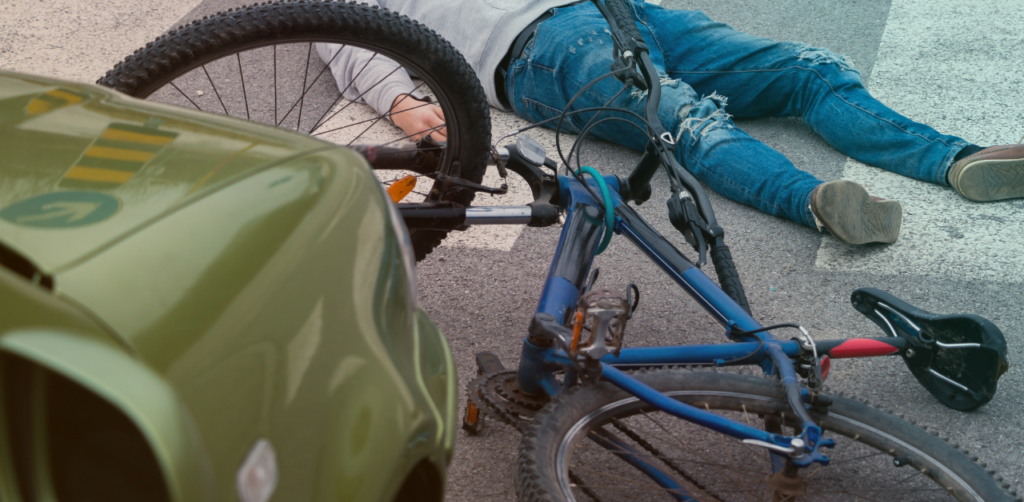
A bicycle collision can leave a rider facing painful injuries, time away from work, and pressure from an insurance company seeking to minimize the claim. When the crash happens near Blue Diamond Road or elsewhere in Southwest Las Vegas, injured cyclists can turn to Temple Injury Law for local legal representation.
Our Blue Diamond office serves riders and families throughout Enterprise, Mountain’s Edge, Rhodes Ranch, Spring Valley, and surrounding Las Vegas communities. We investigate how the bicycle crash occurred, preserve evidence, identify all potentially responsible parties, and pursue compensation available under Nevada law.
You should not have to manage medical care, lost income, and aggressive insurance adjusters on your own. Contact Temple Injury Law for a free consultation about your rights and legal options.
How a Blue Diamond Bicycle Accident Lawyer Can Help
Bicycle accident claims can become disputed even when a motor vehicle driver appears to be responsible. The driver may deny entering the cyclist’s path, claim the rider was difficult to see, or argue that the bicyclist violated traffic laws. The insurer may use those allegations to reduce or deny compensation.
An experienced bicycle accident lawyer can protect you by taking control of the investigation and insurance claim. Depending on the circumstances, our legal team may:
- Visit or examine the accident scene
- Obtain the official police report and 911 records
- Interview witnesses
- Look for traffic, business, doorbell, or dashcam footage
- Preserve the damaged bicycle, helmet, and riding equipment
- Review GPS, fitness-app, or electronic ride data
- Obtain relevant medical records and medical bills
- Analyze vehicle damage and impact evidence
- Determine whether the driver was working at the time
- Identify applicable liability and uninsured motorist coverage
- Calculate current and future financial losses
- Handle communications with insurance companies
- Negotiate for a fair settlement
- File a lawsuit when legal action becomes necessary
Evidence can disappear quickly after a Las Vegas bicycle accident. Nearby surveillance footage may be overwritten, witnesses may become difficult to locate, and physical evidence may be repaired or discarded. Contacting an attorney promptly gives the investigation a better chance of preserving important information.



What to Do After a Bicycle Accident in Southwest Las Vegas
What you do after a bike accident can affect both your health and your ability to pursue a personal injury claim. Take the following steps when you are physically able to do so.
1. Move away from immediate danger
If you are in an active traffic lane and can move safely, get out of the roadway. Do not make sudden movements when you may have suffered a neck, spinal, or head injury.
2. Call 911
Request police and emergency medical assistance. A responding officer can document the parties, vehicles, witnesses, road conditions, and other details. Ask how to obtain a copy of the official police report.
3. Seek medical attention
Accept immediate medical attention when it is recommended. Some traumatic brain injuries, internal injuries, and soft-tissue conditions may not produce obvious symptoms at the accident scene.
Continue with appropriate medical care after leaving the scene. Gaps in treatment may affect your health and allow insurance companies to argue that your bicycle accident injuries were minor or unrelated to the collision.
4. Document the scene
Take photographs or videos when you can do so safely. Capture:
- The bicycle and motor vehicle
- Damage to the bicycle, helmet, and other equipment
- The road, shoulder, intersection, and bike lanes
- Skid marks and vehicle debris
- Traffic signals and signs
- Construction or roadway defects
- Lighting and weather conditions
- Visible injuries
- The position of the bicycle and vehicle
Photograph the entire area as well as close-up details. The wider images may help establish how the driver approached or crossed the cyclist’s path.
5. Collect driver and witness information
Obtain the driver’s name, contact details, license information, vehicle registration, and insurance information. Ask witnesses for their names, telephone numbers, and email addresses.
Do not rely solely on the driver or police officer to record every witness.
6. Preserve your bicycle and equipment
Do not repair, sell, discard, or materially alter your bicycle before it has been inspected and photographed. Preserve your helmet, clothing, lights, electronics, and damaged personal property.
The condition of these items may provide evidence about the direction and severity of the impact.
7. Be careful when speaking with insurers
You may report the accident, but avoid speculating about fault or the seriousness of your injuries. You are not required to accept an immediate settlement simply because an insurance adjuster says the offer is final.
Do not sign a medical authorization, release, or settlement agreement without understanding its effect. A broad authorization may give an insurance company access to years of unrelated medical history.
8. Speak with a bicycle accident attorney
A lawyer can evaluate the available evidence and explain the legal process before you make decisions that could affect your case.
Common Causes of Bicycle Accidents Near Blue Diamond Road
Blue Diamond Road and the surrounding Southwest Las Vegas communities feature a mix of commercial entrances, residential developments, intersections, and stretches where cyclists travel near faster-moving traffic. Drivers must remain alert for bicycles even when a dedicated lane is unavailable.
Bicycle accidents happen in many ways, including:
Unsafe passing
A driver may attempt to pass without providing enough space between the motor vehicle and bicycle. A sideswipe can knock the rider into traffic, a curb, or the roadway.
Right-hook collisions
A right-hook bicycle accident occurs when a driver passes a cyclist and then turns right across the rider’s path. The driver may misjudge the bicycle’s speed or fail to check the vehicle’s mirrors and blind spots.
Left-cross collisions
A driver turning left may enter the path of a cyclist approaching from the opposite direction. These bike crashes can cause severe injuries because the cyclist may strike the side or front of the turning vehicle.
Driveway and parking-lot crashes
Motor vehicle operators leaving shopping centers, apartment communities, gas stations, or other properties may fail to check for an approaching rider before entering the roadway or crossing a sidewalk.
Distracted, impaired, speeding, or inattentive drivers may fail to notice a bicycle ahead. Because a bicycle offers little physical protection, even a relatively low-speed rear impact can cause serious injuries.
Dooring accidents
A driver or passenger may open a parked vehicle’s door into the cyclist’s path. The rider may strike the door directly or swerve into moving traffic while attempting to avoid it.
Drivers fail to yield to cyclists at intersections, stop signs, crosswalks, and property entrances. A driver’s unfamiliarity with bicycle laws does not excuse negligent conduct.
Distracted or impaired driving
Texting, navigation systems, eating, passenger conversations, fatigue, and alcohol or drug impairment can prevent drivers from recognizing an approaching cyclist.
Dangerous road or construction conditions
Loose gravel, potholes, debris, inadequate traffic control, or an unsafe construction zone may contribute to a cycling accident. These cases may involve a property owner, a contractor, or a government entity, in addition to a negligent driver.
Nevada Bicycle Laws That May Affect Your Claim
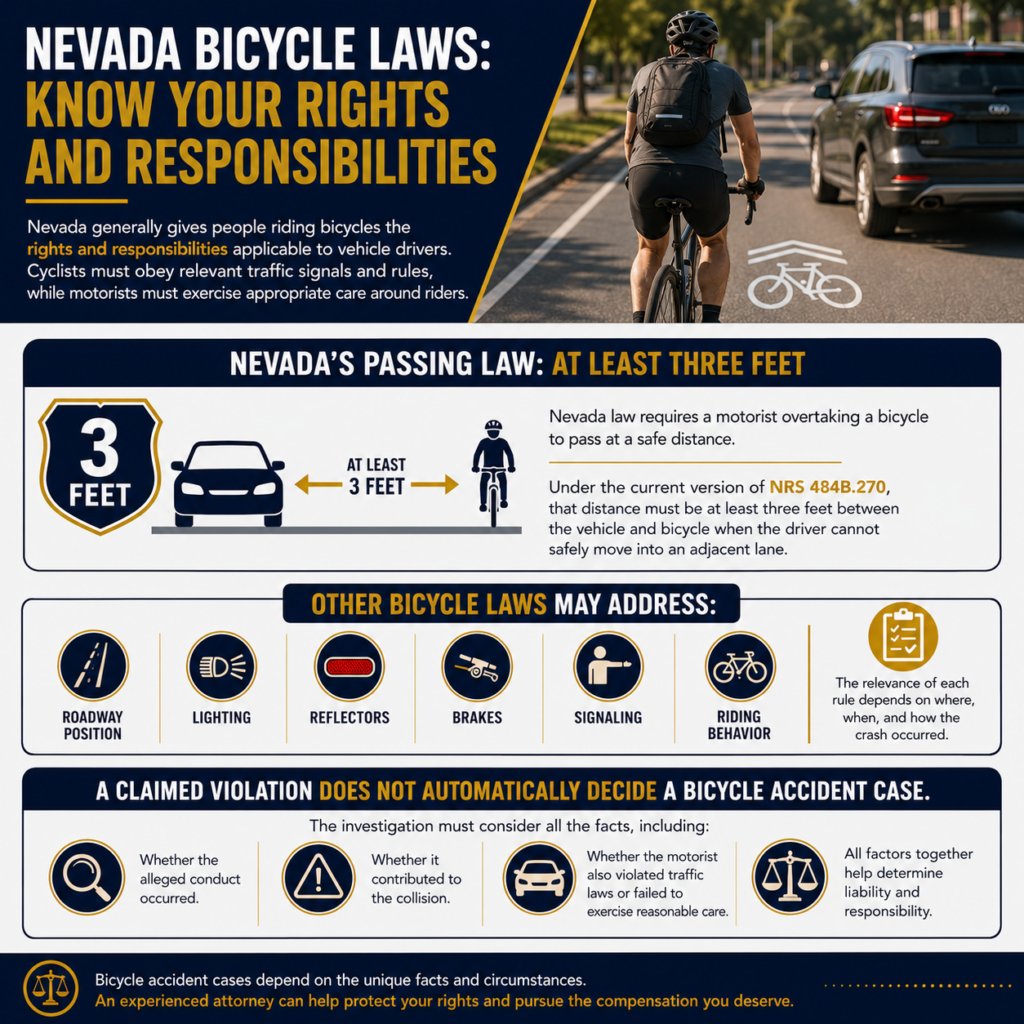
Nevada generally gives people riding bicycles the rights and responsibilities applicable to vehicle drivers. Cyclists must obey relevant traffic signals and rules, while motorists must exercise appropriate care around riders.
Nevada’s passing law requires a motorist overtaking a bicycle to pass at a safe distance. Under the current version of NRS 484B.270, that distance must be at least three feet between the vehicle and bicycle when the driver cannot safely move into an adjacent lane.
Other bicycle laws may address roadway position, lighting, reflectors, brakes, signaling, and riding behavior. The relevance of each rule depends on where, when, and how the crash occurred.
A claimed violation does not automatically decide a bicycle accident case. The investigation must consider whether the alleged conduct occurred, whether it contributed to the collision, and whether the motorist also violated traffic laws or failed to exercise reasonable care.
What If the Cyclist Was Partly Responsible?

Nevada uses a modified comparative-negligence system. An injured person’s negligence does not necessarily prevent recovery when it is not greater than the combined negligence of the parties from whom compensation is sought. Any recovery may be reduced according to the injured person’s percentage of responsibility.
For example, an insurer might argue that a cyclist was partly responsible because the rider:
- Was outside a designated bicycle lane
- Did not have adequate lighting
- Failed to signal before turning
- Entered an intersection too quickly
- Was wearing dark clothing
- Was not wearing a helmet
- Did not take evasive action
Insurance adjusters may use these allegations to shift more blame to bicycle accident victims than the evidence supports.
A thorough investigation may show that the cyclist left a bike lane to avoid debris, a parked vehicle, an unsafe surface, or another hazard. It may also show that the at-fault driver was speeding, distracted, following too closely, passing unsafely, or failing to yield.
Do not assume you have no case simply because you may have made a mistake. Let a qualified personal injury attorney evaluate the complete circumstances.
Evidence Used in Bicycle Accident Claims
A successful claim requires more than an allegation that the driver was careless. The available evidence must connect the at-fault party’s conduct to the collision and the injuries sustained.
Important evidence may include:
Video footage
Traffic cameras, nearby businesses, residential security systems, doorbell cameras, and dashcams may have recorded the bicycle crash. Because recordings are frequently deleted or overwritten, an attorney may promptly send preservation requests.
Witness statements
Independent witnesses may describe the driver’s speed, lane position, turn, passing distance, or actions immediately after the crash.
Physical evidence
Damage to the bicycle, helmet, clothing, and vehicle can help establish where and how the impact occurred.
Electronic information
A bicycle computer, GPS device, smartwatch, fitness application, or mobile telephone may contain route and timing information. In some cases, vehicle data may also assist the investigation.
Police and emergency records
The police report, 911 call, dispatch information, officer photographs, and body-camera footage may provide useful contemporaneous evidence.
Medical documentation
Medical records connect the collision to the diagnosis, treatment, physical therapy, and continuing limitations. They also help document the medical costs associated with the injuries.
Employment and financial records
Pay statements, tax documents, employer letters, and vocational evidence may establish lost wages or reduced earning ability. No single item necessarily proves the entire case. A bicycle accident attorney evaluates how the evidence works together.

Common Bicycle Accident Injuries
The impact between an unprotected cyclist and a motor vehicle can cause injuries requiring emergency treatment, surgery, rehabilitation, and long-term care.
Common bicycle accident injuries include:
- Traumatic brain injuries and concussions
- Head injuries and skull fractures
- Spinal cord and neck injuries
- Broken bones
- Shoulder, wrist, hand, and arm injuries
- Pelvic, hip, leg, and ankle fractures
- Internal bleeding and organ damage
- Dental and facial injuries
- Nerve damage
- Road rash, infection, and scarring
- Torn muscles, ligaments, or tendons
- Psychological trauma and anxiety
Some injured cyclists recover after a period of medical treatment and physical therapy. Others experience permanent injuries that affect mobility, employment, independence, and quality of life.
Severe injuries may also necessitate future surgery, home modifications, assistive equipment, occupational therapy, or ongoing personal care. A claim should account for reasonably anticipated future losses, not only the bills that have already arrived.
Compensation Available After a Bicycle Crash
The compensation available in bicycle accident cases depends on liability, insurance coverage, injury severity, treatment needs, and the effect of the accident on the victim’s life. Recoverable damages may include:
Medical expenses
A claim may seek payment for ambulance transportation, emergency treatment, hospitalization, diagnostic testing, surgery, medication, rehabilitation, physical therapy, and other necessary medical care. Future medical expenses may also be included when the injuries require continuing treatment.
Lost wages and diminished earning capacity
A bicycle accident victim may recover income lost while attending appointments or recovering from injuries. When permanent limitations affect future employment, the claim may also include reduced earning capacity.
Property damage
Compensation may be available for the bicycle, helmet, clothing, electronics, and other personal property damaged in the collision.
Physical and emotional pain
Non-economic damages may account for pain, inconvenience, emotional distress, scarring, disfigurement, loss of enjoyment of life, and the personal effects of serious or permanent injuries.
Wrongful death damages
When a cyclist is killed because of another party’s negligence, qualifying family members and the estate may have rights under Nevada’s wrongful death law. These cases require careful evaluation of who may file and what damages may be pursued.
The value of a personal injury case cannot be determined from an online calculator or an average settlement figure. Every claim depends on its evidence and circumstances.
Who May Be Responsible for a Las Vegas Bicycle Accident?
The motorist who struck the cyclist is not always the only responsible party. A careful investigation may identify one or more potential defendants, such as:
- The at-fault driver
- The vehicle owner
- An employer whose worker caused the collision while performing job duties
- A commercial trucking or delivery company
- A rideshare company or applicable insurer
- A contractor responsible for an unsafe construction zone
- A property owner who created a visibility or access hazard
- A government entity responsible for a dangerous roadway condition
- A bicycle or component manufacturer in a product-defect case
Identifying every at-fault party can be particularly important when the injuries and medical expenses exceed the individual driver’s liability coverage. Special procedures or deadlines may apply to claims involving a public entity. Prompt legal advice can help prevent the loss of important rights.
Why Injured Cyclists Choose Temple Injury Law
Temple Injury Law represents people facing serious personal injury cases throughout the Las Vegas Valley. Jeff Temple and the firm’s attorneys draw on 20+ years of combined legal experience when investigating claims, dealing with insurance companies, and preparing cases for litigation. The firm reports notable results across several types of claims, including a $190,000 bicycle accident recovery, a $1.3 million pedestrian accident recovery, a $495,000 negligent-security recovery, and a $450,000 hit-and-run recovery. Prior results do not guarantee a similar outcome because every matter depends on its own facts, injuries, evidence, and available insurance.
From our office at 8085 Blue Diamond Road, Unit 103, we offer local representation for injured cyclists in Southwest Las Vegas.
When you hire Temple Injury Law, we can:
- Explain your rights and available options
- Manage contact with insurance adjusters
- Conduct a thorough investigation
- Preserve evidence before it disappears
- Work with appropriate medical and technical professionals
- Document economic and non-economic damages
- Pursue a settlement supported by the evidence
- Prepare the case for court when a fair resolution is not offered
Hit-and-Run and Uninsured Driver Claims
A rider may still have options when the driver leaves the accident scene, has no insurance, or does not carry enough coverage to pay for the harm caused.
Applicable uninsured motorist coverage may provide benefits after a hit-and-run or collision involving an uninsured driver. Depending on the policy language and household circumstances, coverage may be available under an automobile policy even if the injured person was riding a bicycle.
These cases may require proof that another vehicle caused the crash, timely reporting, and compliance with policy conditions. Our legal team can examine available insurance policies and investigate whether additional coverage applies.
Do not accept an insurer’s statement that no coverage exists without reviewing the policy and facts.
Frequently Asked Questions
Possibly. Riders are not necessarily required to remain in a bike lane under every circumstance. Road debris, parked vehicles, construction, unsafe pavement, turning movements, and other conditions may affect where a cyclist can safely ride. The absence of a bicycle lane also does not eliminate a motorist’s responsibility to use reasonable care. The entire accident must be investigated.
Potentially. Not wearing a helmet does not automatically make a cyclist responsible for the collision. The insurer may argue that helmet use could have affected certain head injuries, but that is different from determining who caused the crash. The relevance of helmet use depends on the injuries and facts.
You should obtain legal advice before providing one. Insurance adjusters may ask questions designed to obtain statements about fault, speed, visibility, prior injuries, or the severity of your condition.
A statement given before the complete medical picture is known can later be taken out of context.
Preserve it in its post-accident condition. Do not repair, discard, or sell it before it has been fully photographed and, when appropriate, inspected. Keep your helmet, clothing, lights, electronics, and any damaged accessories as well.
Obtain appropriate medical care as soon as possible. Delayed treatment does not always prevent a claim, but it may make it more difficult to establish that the bicycle accident caused the injuries. Tell the medical provider when and how the symptoms began, and follow the recommended treatment plan.
Possibly. An employer may be legally responsible when its employee causes a crash while acting within the scope of employment. Commercial insurance may also provide additional coverage. An attorney can investigate the driver’s job duties, route, employer, and purpose of travel.
Temple Injury Law offers a free consultation. Personal injury cases are generally accepted on a contingency-fee basis, meaning the attorney’s fee is paid from a successful recovery rather than charged upfront. The fee agreement should explain the percentage, litigation costs, and other terms.
Many bicycle accident cases resolve through an insurance settlement, but not every claim can be settled fairly. Litigation may become necessary when the insurer denies liability, disputes the injuries, undervalues damages, or refuses to negotiate in good faith. A trusted bicycle accident lawyer should prepare the evidence with the possibility of trial in mind.

Jeff Temple
Personal Injury Lawyer
Contact our Blue Diamond Bicycle Accident Attorney
You do not have to face an at-fault driver and a powerful insurance company alone. Temple Injury Law can examine the accident, explain how Nevada bicycle accident law may apply, and help you seek compensation for your damages and personal losses.
Contact us for a free consultation. There is no attorney fee unless the firm obtains a recovery for you, subject to the terms of the representation agreement. The sooner we learn about the crash, the sooner we can begin preserving evidence and protecting your claim.
