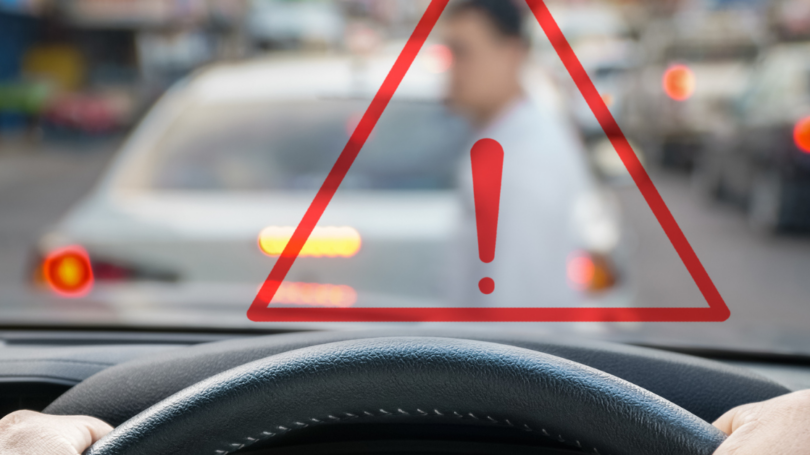
A failure to yield to a pedestrian can be strong evidence of fault when a driver enters a crosswalk and strikes someone. Nevada traffic laws require motorists to yield to pedestrians in specific situations, but drivers must still exercise reasonable care when a person crosses outside a marked crosswalk. These rules are especially important in Las Vegas pedestrian accidents, where serious injuries, pedestrian deaths, and pedestrian fatalities remain significant concerns.
Do pedestrians have the right of way in Nevada? Often, yes, but the answer depends on where the pedestrian crossed, what the traffic signals showed, what the driver could see, and whether each person acted reasonably.
If you were injured, Temple Injury Law helps pedestrians in Las Vegas and Clark County preserve evidence, communicate with the insurance company, and evaluate their personal injury claims.
Pedestrians remain the exception to Nevada’s improving road-safety picture. Through September 2026, the Nevada Office of Traffic Safety reported 261 traffic deaths statewide, down about 9.4% from the same period last year, with Clark County fatalities down nearly 20%. Deaths involving bicyclists, motorcyclists, and unrestrained vehicle occupants all declined. Pedestrian deaths rose, from 72 to 74. In LVMPD’s jurisdiction, 773 of the 18,109 collision reports approved in 2025 involved a pedestrian.
Nevada’s Pedestrian Right-of-Way Laws
Nevada’s pedestrian right-of-way rules begin with NRS 484B.283. When a pedestrian is in a marked crosswalk or an unmarked crosswalk at an intersection, a driver must yield by slowing down or stopping if needed. The rule applies when the pedestrian is on the driver’s half of the road or is approaching closely enough from the other half to create danger. A driver in an adjacent lane may not pass a vehicle that has stopped at a crosswalk to let a pedestrian cross.
An unmarked crosswalk is not the same as crossing anywhere. It is the part of an intersection that connects the lateral lines of sidewalks on opposite sides of the road, even when no paint is present. In marked and unmarked crosswalks, pedestrians should obey traffic signals and pedestrian signals. A green light does not excuse a turning driver from checking the vehicle’s path and yielding to a person who is crossing lawfully.
Pedestrians also have duties. NRS 484B.283 says a pedestrian may not suddenly leave a curb or other place of safety and enter a vehicle’s path when the vehicle is so close that yielding would be impossible. Under NRS 484B.287, someone crossing mid-block outside a marked crosswalk or an unmarked intersection crosswalk generally must yield to vehicles. Between adjacent signal-controlled intersections, pedestrians must use a marked crosswalk.
Those limits do not erase a driver’s broader duty. NRS 484B.280 requires Nevada drivers to exercise due care to avoid a pedestrian collision, use the horn when appropriate, and use proper caution around pedestrians, including near school zones and marked or unmarked crosswalks. The statute calls for added care around a visibly confused or incapacitated person and a blind pedestrian using a white cane or guide dog. These duties matter in downtown Las Vegas, residential neighborhoods, parking lots, and shopping centers, where traffic conditions can change quickly.
When a Driver Fails to Yield: Negligence and Your Claim
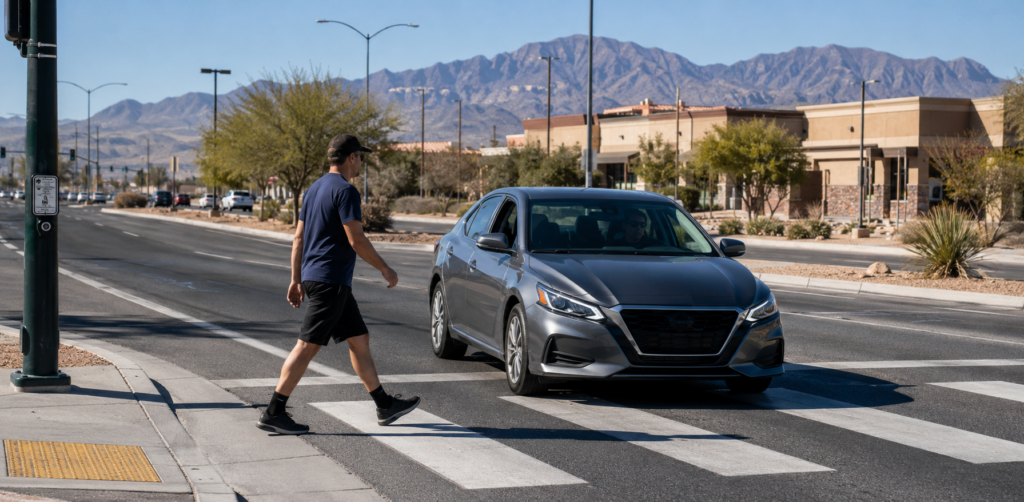
A failure-to-yield accident is usually analyzed as a negligence claim. The injured pedestrian must connect the driver’s conduct to the crash and resulting harm. Proof that the driver broke NRS 484B.283 or failed to use due care under NRS 484B.280 can support fault. Depending on the facts, a personal injury attorney may also argue negligence per se: the violated safety law supplies the standard of care because it was designed to protect people such as pedestrians from this kind of collision. The statutory violation does not eliminate the need to prove causation and damages.
Useful proof may include the police report, accident report, traffic cameras, nearby business video, vehicle damage, phone records suggesting distracted driving, witness statements, and photos of traffic signals, sight lines, skid marks, and the crosswalk. Evidence disappears quickly: video can be overwritten, marks fade, and witnesses become harder to find. A legal team can send preservation requests and compare the physical evidence with what the driver told law enforcement officers.
A personal injury claim may seek compensation for reasonable medical bills, future medical care, physical therapy, lost wages, reduced earning ability, pain, and other legally recognized losses. The insurance company may shift blame or minimize serious injuries. Careful documentation helps show the full effect of the pedestrian accident without promising any particular recovery.
What If You Were Jaywalking or Partly at Fault?

Jaywalking does not automatically defeat a Nevada pedestrian accident claim. A pedestrian who crosses outside a crosswalk may have had a duty to yield, but NRS 484B.280 still requires the driver to use due care. The facts may show that both people contributed—for example, a pedestrian crossed mid-block while a speeding or distracted driver failed to react to a person who was plainly visible.
Nevada’s modified comparative-negligence rule appears in NRS 41.141. You may recover compensation when your share of negligence is not greater than the combined negligence of the parties from whom you seek recovery. In practical terms, the bar applies when the injured person is more than 50% at fault. If you are 50% or less at fault, an award is reduced by your percentage. A person awarded $100,000 and found 20% at fault, for example, would receive $80,000 before other case-specific adjustments.
Because insurers may use crossing location, dark clothing, distraction, or signal timing to shift blame, do not assume an early fault claim is final. A lawyer can investigate whether the driver had time to stop, changed lanes around a stopped car, ignored traffic signals, or drove too fast for the conditions.
Common Injuries When a Driver Fails to Yield
A pedestrian has little protection from a vehicle’s impact or the fall that follows. Even a crash at neighborhood speed can cause serious injuries. Common harm includes broken bones in the legs, hips, arms, or ribs; traumatic brain injuries and concussions; spinal cord and back injuries; internal bleeding; organ damage; severe cuts; and joint or soft-tissue injuries.
Some symptoms appear later. Headache, confusion, abdominal pain, weakness, numbness, or increasing soreness can signal a condition that needs prompt medical attention. Seek medical attention after a crosswalk accident, follow the treatment plan, and tell providers about every symptom. Medical records connect the collision to the diagnosis and show why ongoing medical care or physical therapy is necessary. The value of a claim depends on its evidence and individual facts; no result can be guaranteed.
What to Do If a Driver Failed to Yield and Hit You
- Get to safety and seek medical attention. Call 911 if you can. Accept emergency help and arrange follow-up care, even if adrenaline makes the injuries feel minor.
- Ask for law enforcement. Give an accurate account and obtain the police report or accident report number. Do not guess about speed, distance, or fault.
- Preserve the scene. Photograph the crosswalk, signals, lighting, weather, vehicle damage, injuries, and your clothing. Note businesses or homes that may have traffic cameras or security video.
- Identify the driver and witnesses. Collect the driver’s name, contact details, license plate, and insurance information. Ask witnesses for contact details and save any witness statements.
- Protect the claim. Keep bills, discharge papers, prescriptions, wage records, and a brief symptom log. Avoid posting about the collision. You may decline to give the other insurance company a recorded statement before getting legal advice.
- Speak with a Nevada pedestrian accident attorney immediately. NRS 11.190 generally gives an injured person two years to file a personal injury lawsuit based on another person’s wrongful act, though exceptions can change the deadline. Early legal representation also helps preserve evidence and evaluate every responsible party.
Frequently Asked Questions
Do pedestrians have the right of way in Nevada?
Pedestrians generally have the right of way in marked crosswalks and unmarked crosswalks at intersections when they comply with applicable signals. Drivers must yield as NRS 484B.283 requires. Pedestrians cannot step suddenly into the path of a vehicle that is too close to stop safely.
What if I was jaywalking?
Crossing outside a crosswalk may lead to a share of fault, but it does not automatically prevent recovery. Nevada’s comparative-negligence law may permit a claim if your fault is not greater than the defendants’ combined fault, with compensation reduced by your percentage.
Is failure to yield the driver’s fault?
It can be strong evidence of fault when the driver violated NRS 484B.283, and that violation caused the crash. Investigators still examine signal timing, visibility, speed, crossing location, witness accounts, and whether the pedestrian entered the road too suddenly for a safe stop.
Can I sue if a driver failed to yield?
You may be able to bring a personal injury lawsuit if the driver’s failure to yield caused your injuries and losses. Nevada generally allows two years for injury actions under NRS 11.190, but exceptions may apply. Prompt advice protects your legal rights and evidence.
Hurt by a Driver Who Failed to Yield? Talk to Temple Injury Law
If a driver failed to yield and injured you in Las Vegas or elsewhere in Clark County, Temple Injury Law can review the right-of-way evidence, insurance coverage, medical records, and losses connected to your pedestrian accident. Our legal team can explain the legal process and your options in clear, simple terms. Contact us for a free consultation.

Jeff Temple focuses his practice in the area of personal injury. As a skilled personal injury attorney, he handles a broad range of cases including motor vehicle accidents, premises liability, and wrongful death. He is a graduate of the Radford University, he later attended the University of Miami School of Law and studied abroad at University College London. Upon graduating, Jeff relocated to Las Vegas and founded Temple Injury Law in 2022.

