

Electric scooters are a convenient way to get around Nevada, especially in busy areas like Las Vegas, Clark County, Boulder City, and other communities where riders use them for short trips, recreation, and commuting. But while an electric scooter may feel simple to operate, Nevada law still places important rules on where you can ride, how fast you can go, what equipment your scooter must have, and what may happen if a crash causes injuries.
At Temple Injury Law, Attorney Jeff Temple has helped injured people understand their legal options after serious accidents, including e-scooter accidents. Our firm has handled successful personal injury case settlements for clients who needed help after another person’s negligence caused harm.
This guide explains Nevada’s electric scooter law so riders, parents, pedestrians, and accident victims can better understand their rights and responsibilities.
What Is an Electric Scooter Under Nevada Law?
Under Nevada law, an electric scooter is generally a vehicle with handlebars and an electric motor that is designed to be ridden in an upright or seated position. It can be powered by its electric motor, by the rider, or by both. Nevada’s definition also limits qualifying electric scooters to devices that weigh no more than 100 pounds without a rider and have a maximum motor-powered speed of 20 miles per hour on a flat surface.
That definition matters because not every two-wheeled electric device is treated the same way. An electric scooter is different from a moped, motorcycle, electric motorcycle, or electric bicycle. Those vehicles may be subject to different rules regarding driver’s licenses, vehicle registration, liability insurance, license plate requirements, helmets, and DMV regulations.
In simple terms, Nevada’s electric scooter law means this: if your device meets the legal definition of an electric scooter, you can generally operate it under rules similar to bicycle laws, but you must still follow traffic laws, local ordinances, equipment requirements, and posted restrictions.
Are Electric Scooters Legal in Nevada?
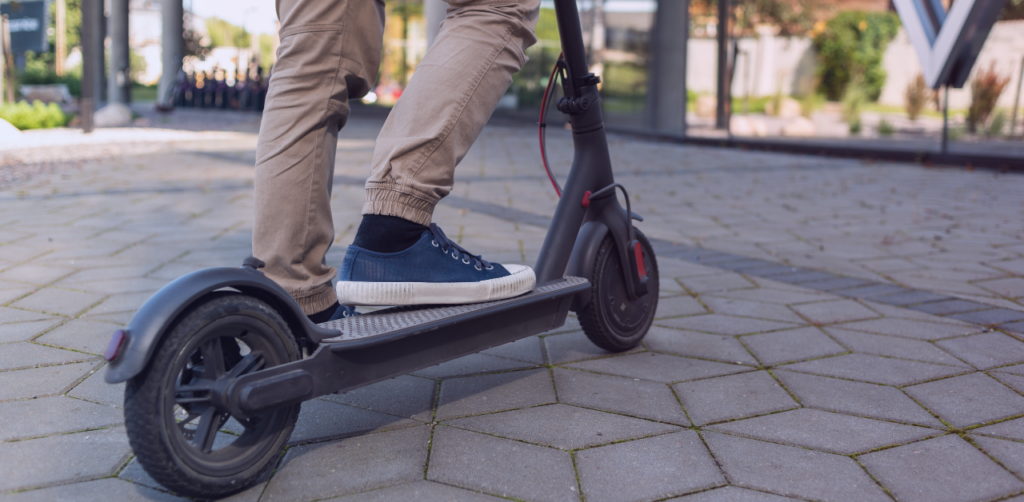
Yes. Electric scooters are legal in Nevada, but riders must follow state law and local regulations. Nevada Revised Statute 484B.785 addresses electric scooter operation, including where scooters may be operated and what rules apply to riders. The statute generally allows electric scooters on roadways, bicycle lanes, paths, and routes, subject to speed restrictions and local ordinances.
Nevada law also gives people riding bicycles, electric bicycles, and electric scooters many of the same rights and duties as drivers of vehicles on the roadway, unless a specific law provides otherwise. That means scooter riders cannot ignore stop signs, traffic signals, pedestrian rights, lane rules, or unsafe riding restrictions simply because they are not driving a car.
Local rules are especially important in Clark County and Las Vegas. Clark County’s public guidance says e-bikes and e-scooters are generally permitted throughout unincorporated Clark County unless signage says otherwise, but county parks, sidewalks, and high-pedestrian areas may have special restrictions.
Where Can You Ride an Electric Scooter in Nevada?
Electric scooters may generally be operated on roadways, bicycle lanes, paths, and routes where they are permitted. In many areas, riders must stay as far to the right as practicable, ride predictably, and comply with the same traffic rules that apply to bicycles and other vehicles.
Depending on the city or county, electric scooters may be allowed in:
- Bike lanes
- Bicycle paths
- Public streets where scooter riding is permitted
- Certain roadways
- Some sidewalks, unless prohibited by local ordinance or signage
- County parks where e-scooters are allowed
- Multi-use paths, subject to posted limits
However, Nevada law allows local governments to regulate electric scooters. This means a scooter ride that is legal in one area may be restricted in another. Clark County, Las Vegas, Boulder City, and other local governments may have their own ordinances covering sidewalks, parks, speed limits, equipment, and unsafe riding.
Can You Ride an Electric Scooter on the Sidewalk in Nevada?
Sidewalk rules depend on where you are riding. In some Nevada neighborhoods, electric scooter riders may ride on sidewalks unless a sign or local ordinance prohibits it. Clark County guidance says riders may use sidewalks in neighborhoods unless signage prohibits operation, but they must yield to pedestrians and use a bell or horn when approaching others.
That does not mean sidewalk riding is allowed everywhere. Some of the busiest pedestrian areas in Southern Nevada restrict or prohibit electric scooters. E-scooters and e-bikes are banned from Las Vegas Strip sidewalks, and restrictions on Fremont Street sidewalks were also adopted in 2025.
Riders should be especially careful in areas with hotels, casinos, crosswalks, crowds, public transit stops, parking garages, and entertainment districts. Even when sidewalk riding is allowed, riders must avoid unsafe conduct and yield to pedestrians.
A safe rule of thumb is this: if you are riding near pedestrians, slow down, use your bell or horn, maintain control of the scooter, and watch for signs prohibiting electric scooter use.
What Is the Speed Limit for Electric Scooters in Nevada?
A qualifying electric scooter generally must have a maximum speed of no more than 20 mph when powered solely by its motor. Nevada’s operation rules also address where scooters may be used and the speed at which they may be operated. NRS 484B.785 states that, unless a local ordinance provides otherwise, an electric scooter may be operated on a roadway, bicycle lane, path, or route at a speed of not more than 15 mph.
Local rules may be stricter. Clark County guidance states that e-bikes and electric scooters are typically limited to 15 mph in county parks unless otherwise posted. Riders should also adjust their speed based on circumstances. A scooter may technically be capable of reaching a certain speed, but that does not make the speed safe. Riders should slow down near pedestrians, intersections, driveways, parked cars, crosswalks, debris, wet pavement, and uneven surfaces.
Reckless riding, stunts, wheelies, unsafe speeds, or behavior that endangers others may result in fines, citations, or liability after a crash.
Do You Need a Driver’s License to Ride an Electric Scooter in Nevada?
Generally, no driver’s license is required to operate a qualifying electric scooter in Nevada. This is one of the reasons electric scooters are popular with tourists, students, and people who want a quick way to travel short distances.
However, this does not mean every electric device can be operated without a license. If the device is actually a moped, motorcycle, electric motorcycle, or another type of motor vehicle, different rules may apply. Those vehicles may require a driver’s license, registration, a license plate, insurance, or motorcycle-specific requirements.
The key question is whether the device meets Nevada’s definition of an electric scooter. If it weighs more than allowed, travels faster than permitted, lacks required handlebars, or functions more like a moped or motorcycle, it may not qualify as an electric scooter.
What Equipment Is Required for Electric Scooters in Nevada?

Electric scooters must be equipped for safe operation. Nevada law and local rules focus on brakes, lighting, reflectors, and warning devices.
A properly equipped electric scooter should have:
- Working brakes
- A bell or horn
- A white front lamp or white light
- A red rear reflector or rear light
- Reflective material when required
- Functional handlebars
- Safe wheels and steering
- Proper lighting for nighttime riding
Clark County guidance lists the required equipment for e-bikes and e-scooters, including brakes, a bell or horn, a white front light, and a red rear reflector or light.
Some safety rules are very specific. Riders may see a lighted lamp visible from a certain distance, a white light on the front, a red reflector on the rear, reflective material visible from a distance, and brakes capable of skidding the wheels on dry, clean pavement. These rules are designed to help riders be seen and heard, and to stop safely.
Equipment matters after a crash, too. If a scooter did not have working brakes, proper lights, or visible reflective material, that may become evidence in a personal injury case. A rental scooter company may also face questions if a scooter was poorly maintained or defective.
Are Helmets Required for Electric Scooter Riders in Nevada?
Helmet rules may depend on the rider’s age and location. Clark County guidance says helmets are recommended for everyone and required for minors operating e-bikes or e-scooters.
Adults are not always legally required to wear helmets when riding a qualifying electric scooter, but wearing one is strongly recommended. Electric scooter crashes can cause serious head injuries, facial injuries, skull fractures, concussions, and traumatic brain injuries.
Parents should be especially careful with children and teenagers. Even when a child is old enough to operate a shared e-scooter, local rules may require a helmet, and parents or guardians may be financially responsible for violations committed by minors under their supervision. Clark County’s ordinance guidance specifically notes parental accountability for minors’ violations.
How Old Do You Have to Be to Ride an Electric Scooter in Nevada?
Age rules can depend on whether the scooter is privately owned or part of a shared rental system. Many shared e-scooter programs require riders to be at least 16 years old, and some rental apps may impose additional requirements in their user agreements.
Local ordinances may also affect where minors can ride and what safety equipment they must use. In Clark County, minors operating e-bikes or e-scooters are required to wear helmets under county guidance.
Parents should not assume that an electric scooter is automatically safe for a child just because it is small or easy to rent. E-scooters can reach significant speeds, operate near motor vehicles, and become dangerous when used on uneven pavement, crowded sidewalks, or multi-lane roads.
What Traffic Laws Must Electric Scooter Riders Follow?
Electric scooter riders must follow traffic laws while riding. In many circumstances, Nevada treats electric scooter riders similarly to bicycle riders. That means riders have rights, but they also have duties.
Electric scooter riders should:
- Obey traffic signals and stop signs
- Yield to pedestrians
- Ride in the proper direction of traffic
- Stay as far to the right as practicable when required
- Use bike lanes where appropriate
- Avoid sudden lane changes
- Signal turns when possible
- Use lights when riding at night
- Avoid unsafe speeds
- Avoid reckless riding
- Follow the directions from a police officer
- Comply with local ordinances and posted signs
Nevada legislation also addresses how bicyclists, electric bicycle riders, and electric scooter riders must approach stop signs and red lights, including when they must stop, when they may proceed cautiously, and when they must yield to pedestrians and vehicles that present an immediate hazard.
Scooter riders should be especially careful when turning left. Multi-lane roads, busy intersections, and high-speed traffic can make left turns dangerous. Riders should turn only when it is safe, legal, and predictable for other road users.
Are Electric Scooters Allowed on the Las Vegas Strip?
Electric scooters are not allowed on Las Vegas Strip sidewalks. This is one of the most important rules for tourists and local riders to know. The Strip is one of the busiest pedestrian areas in Nevada, and sidewalk scooter riding poses serious risks to pedestrians, hotel guests, and riders themselves.
Riders should also be aware that Fremont Street sidewalk restrictions were adopted in 2025. These restrictions reflect growing safety concerns as e-scooters and e-bikes have become more common in crowded entertainment areas.
If you are visiting Las Vegas, do not assume that a scooter rental app will automatically tell you every rule for every sidewalk, street, or pedestrian zone. Watch for signs, avoid crowded sidewalks, and check local restrictions before riding.
What Happens If You Violate Nevada Electric Scooter Regulations?
Under Nevada law, electric scooters generally have the same rights and duties as bicycles and e-bikes and may be operated on roadways, bike lanes, paths, or routes at no more than 15 mph, unless a local ordinance says otherwise. Sidewalk riding depends on local ordinances and posted limits. Possible consequences include:
- Civil traffic infraction: Nevada’s current scooter-related traffic violations are generally treated as civil infractions, not misdemeanors, for acts forbidden or required under NRS 484B.768–484B.790. A civil infraction can carry a penalty of up to $500 per violation, plus administrative assessments, unless another statute authorizes a higher amount.
- Local fines: Local governments can add stricter rules. In unincorporated Clark County, violations of its e-bike/e-scooter ordinance are listed as $150 for a first violation, $300 for a second, and $600 for later violations; parents or guardians are financially responsible for minors’ violations. Boulder City lists similar ordinance penalties of $150, $250, and $600 for bicycle, e-bike, and scooter violations.
- Automatic penalty if you ignore the citation: If you do not respond to a Nevada civil infraction citation within 90 calendar days, the court can enter an order finding that you committed the infraction and assess the monetary penalty and administrative assessments.
- Parental responsibility for minors: Nevada law says a parent or guardian may not authorize or knowingly permit a child or ward to violate Nevada traffic laws. Some local ordinances also make parents or guardians financially responsible for minors’ scooter violations.
- More serious consequences after crashes or reckless conduct: If scooter use contributes to an injury or property damage, you may face civil liability, and depending on the facts, police may cite other traffic or reckless-operation laws. Motorists also have duties toward scooter riders, and Nevada law imposes added penalties when certain driver violations cause collisions with scooter riders.
- Your device might be treated as something else: Nevada defines an electric scooter as a device with handlebars and an electric motor that weighs 100 pounds or less and has a motor-powered maximum speed of 20 mph or less. If the vehicle is faster/heavier or resembles a moped or motorcycle, different rules may apply. For example, the Nevada DMV says that mopeds require a driver’s license, a helmet, registration, and a license plate.
Can a Motor Vehicle Driver Be Liable for Hitting an Electric Scooter Rider?
Yes. A motor vehicle driver may be liable if careless or unlawful driving causes a crash with an electric scooter rider. Nevada law requires drivers to use due care around people riding bicycles, electric bicycles, electric scooters, and pedestrians. Drivers may not intentionally interfere with the movement of a lawful scooter rider, and they must be careful when passing or driving near bicycle lanes and paths.
Driver negligence may include:
- Distracted driving
- Speeding
- Failing to yield
- Unsafe lane changes
- Opening a car door into a rider’s path
- Driving in a bike lane
- Running a red light
- Turning without checking for scooters
- Driving under the influence
- Failing to leave enough space when passing
- Ignoring pedestrians and scooter riders in crosswalk areas
When a motor vehicle hits an electric scooter rider, the injuries can be severe. Scooter riders have little protection compared with people inside cars. A collision may cause broken bones, head injuries, spinal injuries, road rash, and long-term medical problems.
Can an Electric Scooter Rider Be Liable for a Crash?
Yes. Electric scooter riders can also be liable if their own careless or reckless conduct causes injury to another person. A rider may be negligent if they:
- Ride too fast for conditions
- Hit a pedestrian on a sidewalk
- Ignore a stop sign or red light
- Ride in a prohibited area
- Fail to yield
- Ride without lights at night
- Weave through traffic
- Perform stunts
- Carry a passenger unsafely
- Ride while impaired
- Use a defective scooter they know is unsafe
However, liability is not always all-or-nothing. More than one person may share fault. For example, a driver may have failed to yield while the scooter rider was also traveling too fast. In those cases, Nevada’s comparative negligence rules may affect how compensation is calculated.
Who May Be Responsible After an Electric Scooter Accident?
Electric scooter accident liability depends on how the crash happened. In some cases, one person is clearly at fault. In others, several parties may share responsibility.
Potentially liable parties may include:
- A negligent motor vehicle driver
- A reckless scooter rider
- A rental scooter company
- A scooter manufacturer
- A maintenance contractor
- A property owner
- A business owner
- Parking garage operator
- A city, county, or government entity
- A pedestrian or bicyclist in limited circumstances
A rental scooter company may be involved if the scooter had defective brakes, poor lighting, worn tires, steering problems, or other maintenance issues. A property owner may be responsible if unsafe pavement, a hidden hazard, poor lighting, or dangerous premises contributed to the crash. A government entity may be involved if a dangerous public roadway, bike lane, sidewalk, or path contributed to the incident. The same theory that applies when suing a city for bad roads.
Because these cases can involve traffic laws, product safety, premises liability, and insurance issues, it is important to investigate quickly.
Common Causes of Electric Scooter Accidents in Nevada
Electric scooter crashes can happen for many reasons. Some involve rider error, while others involve unsafe drivers, poor infrastructure, defective equipment, or dangerous property conditions.
Common causes include:
- Motor vehicles are turning into scooter riders
- Drivers failing to check bike lanes
- Distracted driving
- Speeding
- Poorly maintained scooters
- Defective brakes
- Lack of lights or reflectors
- Uneven sidewalks
- Potholes
- Loose gravel
- Wet pavement
- Crowded sidewalks
- Unsafe road design
- Poor visibility at night
- Reckless riding
- Riders losing control
- Pedestrians stepping into a scooter’s path
In Las Vegas and Clark County, tourist traffic, rideshare vehicles, casino entrances, buses, parking lots, and crowded sidewalks can increase the risk of crashes. Scooter riders should assume that drivers and pedestrians may not see them.
Injured in an Electric Scooter Accident in Nevada?
Nevada’s electric scooter laws are designed to keep riders, pedestrians, bicyclists, and drivers safer. But when someone ignores the rules, rides recklessly, drives carelessly, or fails to maintain safe equipment or property, serious injuries can happen.
If you were injured in an electric scooter crash in Nevada, Temple Injury Law can review what happened, explain your options, and help determine who may be legally responsible. Contact us for a free case evaluation to discuss your case and learn what steps may help protect your claim.

Jeff Temple focuses his practice in the area of personal injury. As a skilled personal injury attorney, he handles a broad range of cases including motor vehicle accidents, premises liability, and wrongful death. He is a graduate of the Radford University, he later attended the University of Miami School of Law and studied abroad at University College London. Upon graduating, Jeff relocated to Las Vegas and founded Temple Injury Law in 2022.

