

Data current as of August 23, 2026. Sources: LVMPD weekly and year-end traffic reports, Nevada Office of Traffic Safety, NDOT.
Las Vegas car accident statistics show 10,953 crashes in LVMPD jurisdiction. That is the January 1 through August 23, 2026 count in the agency’s latest weekly traffic report. That equals about 46.6 crashes per day during those 235 days, which was 6.4% lower than the same period in 2025. LVMPD also recorded 79 traffic deaths, down 26.9% from 108 a year earlier. These numbers are not final. Still, they give the clearest current answer to how many car accidents are occurring on Las Vegas roads.
The data matters for residents, visitors, and accident victims trying to understand where, when, and why accidents in Las Vegas occur and how that can affect a future car accident claim.
Las Vegas Crash Numbers at a Glance
For a full-year baseline, use the Las Vegas car accident statistics in LVMPD’s 2025 year-end report. It counted 18,109 approved collision reports. That was 1.8% fewer than the 18,433 reported for 2024. Dividing the 2025 total by 365 gives an average of 49.6 crashes per day. The same report separates the total this way:
| 2025 LVMPD measure | Official count |
|---|---|
| Injury crashes | 11,534 |
| Non-injury crashes | 6,575 |
| Pedestrian-related crashes | 773 |
| Traffic deaths | 163 deaths in 158 fatal collisions |
Those boundaries matter. LVMPD data covers its law-enforcement jurisdiction across much of the Las Vegas Valley, including unincorporated Clark County. It is not a city-limits-only total, and it does not include crashes handled by the Henderson or North Las Vegas police departments, which report separately. Valley-wide totals are therefore higher than the LVMPD figures alone. Likewise, the report says certain station-only P1 hit-and-run reports are not entered as collisions.
Clark County Leads Nevada in Traffic Deaths
The latest statewide county comparison reinforces how heavily Southern Nevada shapes Nevada traffic accident statistics. In its April 6, 2026 State Fatal Report, the Nevada Office of Traffic Safety listed 235 Clark County fatalities for 2025. Its county table accounts for 380 fatalities statewide. Hence, Clark County represents about 61.8% of that total. The county had 296 of 420 statewide deaths in 2024. The number fell 20.6% from the previous year but was still much higher than in any other county.
The OTS report is a point-in-time comparison. It says the 2025 data will not be final until the federal Fatality Analysis Reporting System release in 2027. Its statewide headline total is 381, while the county table accounts for 380. That one-death difference is why the source date and denominator belong beside any percentage. It is also why rounded claims such as “about two-thirds” are safer only when the exact figures are shown nearby.
What’s Driving the Crashes
The large majority of crashes involve driver behavior rather than weather, mechanical failures, or road defects. Nevada OTS collision reports break out the key factors contributing to fatal and serious accidents:
- Impaired driving. Impaired driving accounts for roughly 29% of traffic deaths in the Las Vegas area, according to statewide analyses. Driving under the influence remains a leading catalyst for nighttime collisions, tied to the city’s late-night traffic patterns. Some DUI numbers have trended down due to enforcement and rideshare use, but the share of deaths remains high.
- Speeding and aggressive driving. Speeding is identified as a major contributor to fatal crashes. Nevada recorded 119 speeding-related fatalities statewide in 2024. Excessive speed reduces reaction time and increases crash severity. Tailgating and weaving through lanes on I-15 at the Spaghetti Bowl (I-15/US-95 interchange) and on surface arterials such as Flamingo Road and Sahara Avenue are recurring issues.
- Failure to yield. Failing to give other drivers or pedestrians the right of way has been a major factor in local traffic deaths, with Zero Fatalities Nevada data showing a sharp rise in failure-to-yield deaths between recent reporting periods.
- Distracted driving. Mobile device usage contributes to distracted driving incidents, and OTS tracks distracted driving fatalities against annual reduction targets it has recently missed.
- Drowsy driving and inexperienced drivers. Risky behavior by drowsy drivers and inexperienced drivers increases crash risk, especially on congested roads during heavy traffic hours.
Speeding and distracted driving are major causes of accidents in the Las Vegas Valley. Poor road design also contributes to high accident rates: wide, fast roads with long crossing distances and limited lighting interact with human error to make routine trips dangerous.
Pedestrians and Vulnerable Road Users
Data shows that nearly half of traffic fatalities involved pedestrians, bicyclists, or motorcyclists. Pedestrian fatalities account for a significant share of total deaths in Nevada, and Clark County recorded 370 fatal VRU crashes and 695 serious-injury VRU crashes between 2019 and 2023.
Certain corridors appear repeatedly in local crash analyses and enforcement campaigns, including the I-15/US-95 interchange, Flamingo Road, Tropicana Avenue, Boulder Highway, Sahara Avenue, and downtown surface streets. These are high-volume routes carrying heavy commercial traffic alongside pedestrians, and they concentrate the conditions that produce serious crashes.
High-risk areas are densely populated with both locals and tourists. Las Vegas roads are risky for people on foot because of wide arterials, high-speed traffic, heavy foot traffic in tourist areas, long distances between safe crossings, and distracted drivers. Pedestrian accidents on these corridors often result in fatal or life-altering injuries, fueling safety campaigns and local enforcement operations, especially when sudden rain or hazardous weather conditions make roads slick.
Why the Numbers Matter
Each number in these Las Vegas car accident statistics represents a person or family dealing with loss, pain, and financial stress. Many victims face emergency treatment, follow-up care, lost wages, vehicle replacement, and emotional trauma. When a family loses a loved one in a crash, the consequences extend far beyond the data tables.
Common car accident injuries include whiplash, fractures, and concussions. Even “minor” collisions can lead to hidden soft-tissue damage that surfaces days later. Injuries from crashes can lead to significant medical expenses and medical bills that accumulate quickly, especially when surgery or long-term rehabilitation is involved.
Most importantly, public officials use Clark County crash statistics to target problem corridors, fund engineering changes on certain intersections, and shape enforcement on local roads. Injured individuals use the same data contextually when pursuing insurance and legal claims for fair compensation.
What to Do If You’re in a Las Vegas Crash
- Move to safety and call 911. Get yourself and passengers out of traffic if possible.
- Get medical care immediately, even if injuries seem minor. Some common car accident injuries, like concussions, do not show symptoms right away.
- Ensure a police report is filed. Contact LVMPD or file an online report. Nevada law requires a DMV crash report for crashes involving injury, death, or property damage above the reporting threshold.
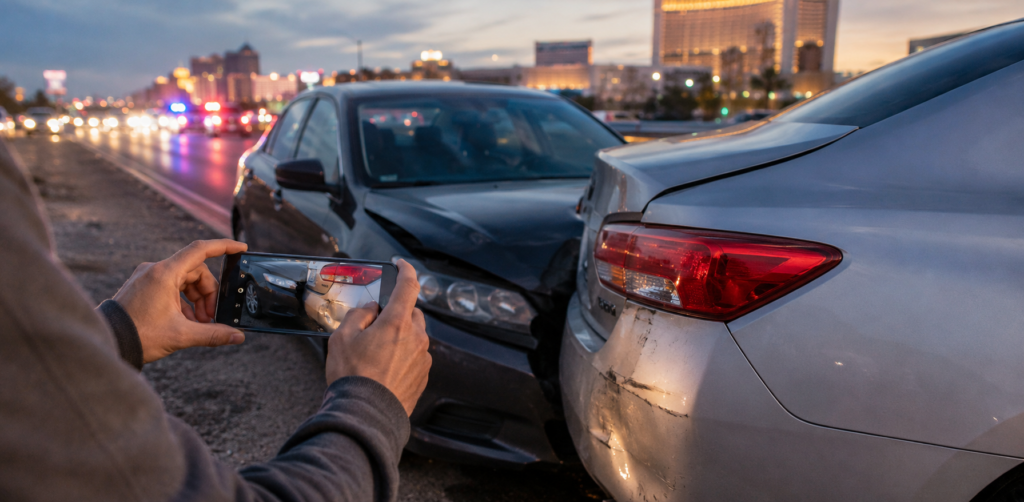
- Document the scene. Take photos and video of damage, skid marks, traffic signals, road conditions, and any brake failures or tire blowouts visible on vehicles.
- Gather witness names and exchange information with the other driver, including insurance details and license plate numbers.
- Do not give a recorded statement or accept a quick settlement from insurers before you understand your injuries and medical expenses.
- Preserve evidence: medical records, repair estimates, dash-cam footage, and rental car receipts.
- Contact a local injury law firm for a free case evaluation. An attorney can explain fault, comparative negligence rules, and what your claim may involve under Nevada law.
How Long Do You Have to File in Nevada?
Most car accident lawsuits must be filed within two years of the date of injury under NRS 11.190. Missing this deadline usually means losing the right to compensation entirely. The two-year statute of limitations applies to personal injury claims from Las Vegas car crashes, including pedestrian and bicycle crashes. However, property-damage-only claims and cases involving government entities may follow different rules.
Certain exceptions, like injuries to minors or delayed discovery of an injury, can affect how the deadline is calculated. Only a Nevada attorney can apply those rules to a specific case. Insurance companies know these time limits and may delay or minimize claims. That is why many accident victims choose to seek experienced legal guidance early, rather than waiting until the end of the two-year window.
Frequently Asked Questions
What if law enforcement does not investigate the crash at the scene?
The Nevada DMV says an SR-1 Report of Traffic Crash must be filed within 10 days when a crash in Nevada was not investigated at the scene by law enforcement and resulted in injury, death, or more than $750 in damage. The form requires proof of insurance and may also require a repair estimate, a total-loss statement, and a doctor’s statement of injury.
What auto liability insurance does Nevada require?
Nevada requires owners of registered vehicles to maintain at least $25,000 in bodily-injury liability coverage for one person, $50,000 for two or more people in one crash, and $20,000 for property damage. These 25/50/20 limits are minimums, so a serious crash can result in losses that exceed the required coverage.
What if the other driver has no insurance or not enough coverage?
Nevada’s Division of Insurance explains that uninsured/underinsured motorist coverage can help with medical costs when the other driver is at fault but has no insurance or insufficient coverage to cover the loss. Whether that coverage applies and how much is available depends on the policy’s terms and limits.
Does required liability insurance pay for damage to my own car?
Liability coverage is designed to pay damages to others when the insured is legally responsible for a crash. Collision coverage, if purchased, covers damage to your own vehicle from a collision regardless of fault. Nevada does not require collision or comprehensive coverage, so the available protection depends on the policy you bought.
Hurt in a Las Vegas Crash? Talk to Temple Injury Law
Public data can show a pattern, but your case turns on its own evidence, insurance coverage, injuries, and losses. If you or someone you love was hurt in a Las Vegas car accident, our team at Temple Injury Law is always ready to help. Contact us for a free consultation to discuss your car accident case.

Jeff Temple focuses his practice in the area of personal injury. As a skilled personal injury attorney, he handles a broad range of cases including motor vehicle accidents, premises liability, and wrongful death. He is a graduate of the Radford University, he later attended the University of Miami School of Law and studied abroad at University College London. Upon graduating, Jeff relocated to Las Vegas and founded Temple Injury Law in 2022.

