

A car crash can be over in seconds. The insurance paperwork can last much longer. After an accident, how long it takes to receive an insurance payout depends on several factors. These include the type of claim, whether the insurer has all the required documents, whether liability is disputed, and whether the claim involves vehicle damage, personal injury protection, bodily injury, or another form of coverage.
The National Association of Insurance Commissioners says some states set specific deadlines for insurance claims, while others simply require insurers to pay claims within a “prompt and reasonable” time. Claims that need more investigation or are filed during busy periods may take longer.
There is no single national clock for car insurance payouts. In some states, the countdown begins after an insurer accepts the claim. In others, it begins after proof of loss, a settlement agreement, an affirmation of liability, or receipt of signed settlement documents.
To compare how those timelines vary, Temple Injury Law, a personal injury law firm, reviewed claims-settlement provisions compiled by the National Association of Insurance Commissioners and identified the payment benchmark most relevant to auto, property and casualty, liability, or all-line insurance claims in each state.
The fastest payout clocks often start after agreement or acceptance
Some of the shortest listed payout windows begin only after the insurer has already accepted the claim or the parties have reached a settlement.
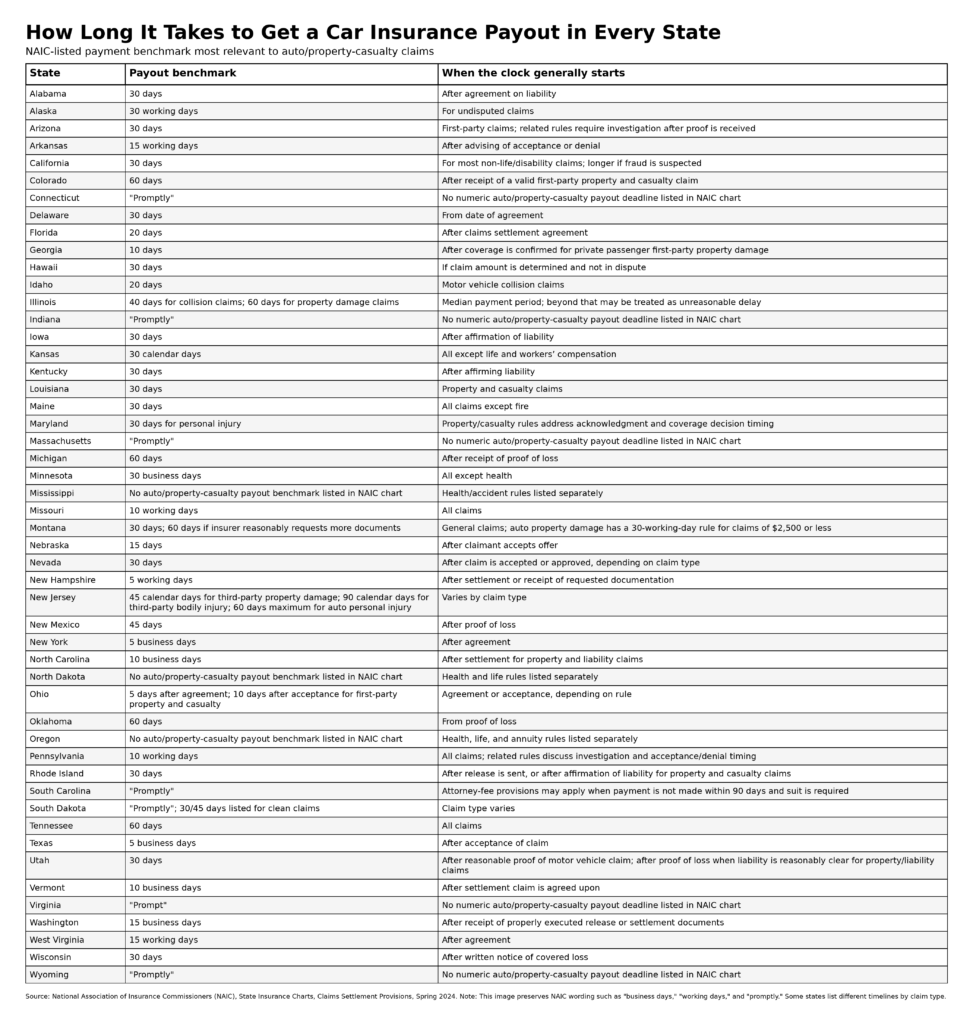
New York requires payment within 5 business days after the agreement under Regulation 64. Ohio lists 5 days after agreement for all claims, with a separate 10-day window after acceptance for first-party property and casualty claims. Texas requires payment no later than 5 business days after acceptance of a claim, with a longer 20-business-day rule for eligible surplus lines. New Hampshire also has a short window for property and casualty claims: 5 working days after settlement or after receiving documentation needed to process the claim.
Those short deadlines do not mean a driver will receive money within five days of a crash. They typically apply after the claim is accepted, settled, or adequately documented.
The NAIC data below shows the state-by-state breakdown of how payout benchmarks differ across the country and what event typically starts the clock.
Why the same accident can move at different speeds
The payout clock is not always triggered by the crash itself. In many states, the timeline starts later, after the insurer receives proof of loss, confirms coverage, accepts liability, receives a signed release, or reaches a settlement with the claimant.
That distinction matters because a claim may involve several stages before payment: reporting the crash, opening a claim, inspecting the vehicle, reviewing a police report, determining fault, collecting medical bills, confirming coverage, and resolving disputes over repair costs or injury damages.
In Alabama, for example, the NAIC chart lists a 30-day payment window after agreement on liability for property and casualty claims. Alaska lists 30 working days for undisputed claims and separate rules for acknowledging and accepting or denying first-party claims. California lists 30 days for most claims but also notes that insurers generally must acknowledge claims within 15 days and accept or deny them within 40 days unless additional time is needed.
Other states tie deadlines to later claim milestones. Nebraska requires property and casualty insurers to make payment 15 days after a claimant accepts an offer. Washington requires payment of a settled claim within 15 business days after receipt of properly executed release or settlement documents.
The practical takeaway for drivers
A state’s deadline is best understood as a claims-handling benchmark, not a guaranteed payout date after a crash. The most important question is not only how many days a state allows, but what event starts the clock.
For drivers waiting on payment, that means documentation can matter as much as the deadline itself. A repair estimate, proof of loss, medical records, signed release, or other requested paperwork may determine whether a claim is considered ready for payment. In disputed claims, the process can stretch further, especially when an insurer requests additional information or issues periodic delay notices permitted under state rules.
The rules also show why payout timelines vary widely across the country. Some states set short post-settlement deadlines measured in business days. Others use 30- or 60-day payment windows. A smaller group relies on a general requirement that insurers act “promptly,” leaving more of the timing to the facts of the claim and the state’s claims-handling standards.

Jeff Temple focuses his practice in the area of personal injury. As a skilled personal injury attorney, he handles a broad range of cases including motor vehicle accidents, premises liability, and wrongful death. He is a graduate of the Radford University, he later attended the University of Miami School of Law and studied abroad at University College London. Upon graduating, Jeff relocated to Las Vegas and founded Temple Injury Law in 2022.

