

Yes — U-turns are legal in Nevada in most locations, as long as no sign prohibits the turn and it can be completed safely. A legal U-turn in Nevada depends on four facts: the location, the posted traffic sign, the driver’s view, and the movement of nearby vehicles. A turn that looks open can still be an illegal U-turn in a business district, a school zone, a one-way street, or a divided highway without a marked opening. It can also become unsafe in seconds when oncoming traffic closes the gap.
This guide breaks down Nevada laws on U-turns, covering intersections, red lights, highways, and residential streets. You’ll learn about traffic signs, center lanes, and legal restrictions in cities like Las Vegas. Whether you’re a new driver or need a refresher, understanding Nevada U-turn laws helps you avoid tickets and drive safely.
As experienced car accident lawyers at Temple Injury Law, we’re dedicated to clarifying Nevada’s U-turn laws. We aim to equip you with the information and assistance to navigate Nevada’s roads confidently and responsibly.
Are U-Turns Legal at Nevada Intersections and Traffic Signals?
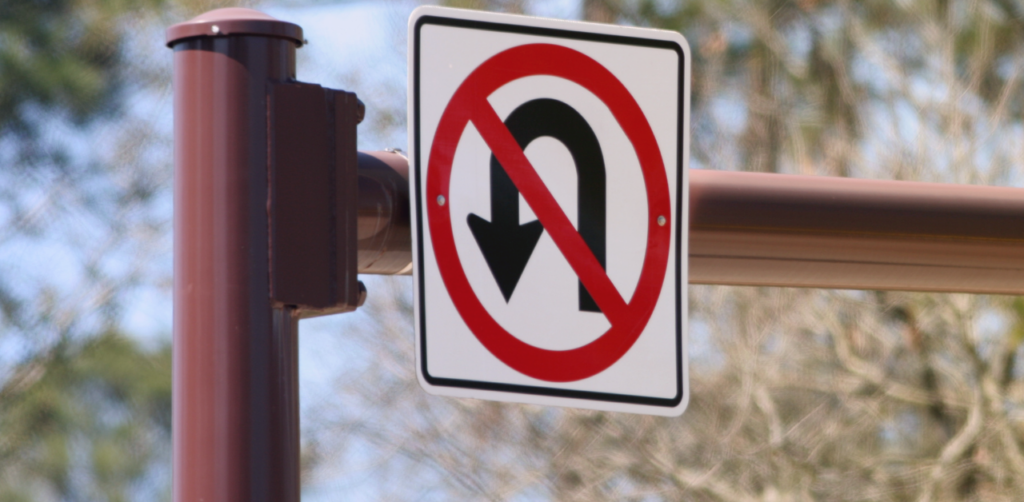
A U-turn is generally allowed at a Nevada intersection on a green traffic signal light or green arrow unless a No U-Turn sign or another official traffic control device prohibits the maneuver. A green signal does not give the turning driver an unchecked right to move. The driver must still yield to pedestrians, oncoming traffic, a vehicle approaching at a lawful speed, and other drivers who have the right-of-way.
Because a U-turn is completed on a green signal or green arrow, a driver stopped at a red light must wait for the green before turning — you cannot make a U-turn on a red light in Nevada the way you might a right turn on red. Before entering the intersection, move into the far left lane or a lane marked for a left turn. Signal early and wait until there is enough space to reach the opposite direction in one continuous movement. If the turn cannot be completed safely without forcing other vehicles to brake or change lanes, wait or continue to another legal location.
Does “Left Turn Only” Mean No U-Turn in Nevada?
A “Left Turn Only” sign or lane arrow controls the movements permitted from that lane. On its own, it does not automatically prohibit a U-turn in Nevada — a driver in a left-turn lane may still make a U-turn unless a separate “No U-Turn” sign or another traffic control device is posted at that location. Always read every sign at the intersection before turning. When a “No U-Turn” sign appears alongside the left-turn arrow, the U-turn is prohibited even though the left turn is allowed.
U-Turns Across Double Yellow Lines and Center Turn Lanes
The Nevada Driver’s Handbook states that a legal U-turn may cross a double yellow line when the turn is safe and otherwise permitted. The double yellow line does not, by itself, create a statewide ban on U-turns. Signs, visibility, traffic flow, and the surrounding road design still control the decision.
A driver may also start from a center left-turn lane when the lane is available, and the maneuver is legal. The center lane is not a travel lane. Enter it close to the turning point, signal, check both directions, and make the U-turn without using the passing lane or building speed. Heavy traffic, a high posted speed limit, or limited visibility can make an otherwise legal U-turn too risky to attempt.
U-Turns on Divided Highways and Median Openings
On a divided highway, a U-turn is legal only where an appropriate opening or crossing place exists in the center divider. The opening must be designed or left open for vehicles to cross. Drivers may not create a shortcut by driving over a curb, a raised center divider, a strip of land, a painted dividing section, or two sets of double yellow lines.
This rule matters on wide Las Vegas roads where the next median opening may be several blocks away. An opening does not automatically make the turn safe. A responsible driver still checks the speed and distance of approaching vehicles, the number of lanes to cross, and any sign prohibiting U-turns. When no proper opening exists, continue to the next intersection or designated turnaround.
U-Turns in Residential Districts and Business Areas
In a residential district, the Nevada Driver’s Handbook allows a U-turn when a traffic sign, light, or traffic signal light protects the driver from approaching vehicles. In other words, U-turns in residential districts are legal when the driver is shielded from oncoming traffic. A driver should also confirm that the street is wide enough and that parked cars, driveways, cyclists, and pedestrians do not block the path.
Business districts follow a narrower rule. Under NRS 484B.403, a driver may not make a U-turn in a business district except at an intersection or on a divided highway where an appropriate opening or crossing place is provided. Areas with churches, apartments, multifamily housing, and public buildings may fall within the business district rule. In business areas with frequent foot traffic, a legal turn can still pose a higher risk when executed without sufficient space.
Can You Make a U-Turn in a School Zone in Nevada?
Nevada law generally prohibits a U-turn in a school zone or school crossing zone while the restriction is in effect. The law provides limited exceptions, including the following situations:
- No children are present.
- School is not in session that day.
- The time falls from one-half hour after school ends to one-half hour before the next school session begins.
- Flashing school-zone lights or a posted sign show that the restriction is not in effect.
Drivers should read the full sign and watch for children present near the roadway. A turn that starts outside the marked zone may still place a child at risk if the vehicle crosses a school entrance, sidewalk, or crossing path. When the sign or flashing lights are unclear, continue forward and use another intersection.
Where Are U-Turns Never Allowed? Curves, Hills, Railroad Crossings, One-Way Streets, and Fire Stations
Some locations are poor or prohibited places for a U-turn because approaching traffic cannot react in time. The Nevada Driver’s Handbook tells drivers never to make a U-turn in these settings:
- At or on a railroad crossing.
- On a one-way street.
- In front of a fire station or through a fire station driveway.
- Where a curve, hill, rain, fog, or another condition prevents a clear view for 200 feet in each direction.
- Near a grade where visibility is less than 500 feet in both directions.
- At any location where other vehicles may hit the turning vehicle.
The 200-foot and 500-foot visibility rules address different road conditions. Drivers should not treat either distance as a target to meet in heavy traffic. Speed, weather, road width, and the time needed for a motor vehicle to complete the turn are other factors. If an approaching driver needs to brake sharply, the U-turn is not being executed safely.
U-Turns Restricted by Signs, Local Rules, and Work Zones
A traffic sign or official traffic control device can prohibit U-turns at a specific location. NRS 484B.403 also permits local authorities and the Nevada Department of Transportation to prohibit U-turns within their respective jurisdictions. This means Nevada drivers must follow local restrictions even when the general state rule would normally allow the turn.
Work zones require added care. Lane shifts, temporary center lines, workers, equipment, and narrowed lanes can remove the space needed to make a U-turn. Nevada law allows an additional penalty for certain violations committed in a marked temporary traffic control zone when workers are present or construction conditions make the act more dangerous. A sign stating “Double Penalties in Work Zones” should be read together with all temporary arrows, cones, and lane-control signs.
How to Make a Legal U-Turn Without Disrupting Traffic
A legal U-turn must also be completed safely. Use this sequence before turning:
- Check for a No U-Turn sign, a sign prohibiting the movement, or a local restriction.
- Confirm that the road is not a one-way street, a railroad crossing, a blocked median, an active school zone, or another prohibited location.
- Move into the left lane or center left-turn lane and signal early.
- Look for oncoming traffic, pedestrians, cyclists, and vehicles entering from driveways or side streets.
- Wait for a gap large enough to complete the movement without stopping across travel lanes.
- Turn into the proper lane going in the opposite direction and match the traffic flow only after the vehicle is straight.
Do not make a U-turn because another driver waves you through. That driver may not see a vehicle approaching in the next lane. If the opening closes, cancel the turn. Missing a destination costs less time than a crash, a traffic violation, or a dispute over fault.
Penalties for an Illegal U-Turn in Nevada: Tickets, Points, and Insurance

An illegal U-turn can result in a traffic citation, a court-assessed penalty, and added costs. The amount is not a single statewide figure. It can vary by court, local schedule, work-zone status, and related violations. This is why a fixed dollar estimate for an illegal U-turn ticket can mislead Nevada drivers.
A conviction may also appear on the driving record. Nevada’s DMV assigns demerit points after courts report moving traffic convictions. The exact points depend on the violation code and any related offense. The DMV states that 12 or more demerit points within 12 months result in an automatic six-month suspension. A person with a valid driver’s license should review the citation and DMV record rather than assuming that an illegal U-turn always carries a set number of points.
The insurance company may consider the citation, prior traffic violations, and the crash record when setting rates or handling a claim. A citation alone does not answer every civil-liability question. The road design, signals, witness accounts, vehicle positions, and conduct of other drivers can change the analysis.
Contact Temple Injury Law for Skilled Advice on Nevada U-Turn Laws
Temple Injury Law is here to assist you regarding U-turn laws in Nevada. Our team of knowledgeable professionals understands the intricacies of traffic laws and is well-equipped to provide the support and guidance you need. So, we are just a phone call away if you’re seeking information about legal U-turns or require assistance with the consequences of an illegal U-turn in Las Vegas or anywhere in Nevada.
By partnering with Temple Injury Law, you gain access to experienced attorneys who will help you understand the law and work diligently to protect your rights. Schedule a consultation with us, and we’ll guide you through the complexities of U-turn laws in Nevada.
Nevada U-Turn Laws: Frequently Asked Questions
Yes. U-turns are legal in Nevada in most locations when no sign prohibits the turn and it can be completed safely with a clear view of traffic in both directions. Restrictions apply in business districts, school zones, one-way streets, near fire stations, and at railroad crossings.
A U-turn is completed on a green signal or green arrow, so a driver at a red light should wait for the green. Unlike a right turn on red, there is no general allowance to make a U-turn while the light is red.
No. The Nevada Driver’s Handbook lists one-way streets among the places where drivers should never make a U-turn.
No. Drivers should never make a U-turn in front of a fire station or across a fire station driveway.
Under NRS 484B.403, a U-turn in a business district is allowed only at an intersection or on a divided highway where an appropriate opening or crossing place is provided.
Yes, when a traffic sign, light, or signal protects the driver from approaching vehicles and the street is wide enough to complete the turn safely.
There is no single statewide fine or point value. The cost and demerit points depend on the court, the specific violation code, whether it occurred in a work zone, and any related offenses. Review your citation and DMV record for the exact amounts.
Do not make a U-turn where a curve, hill, or weather blocks a clear view for at least 200 feet in each direction, or near a grade with less than 500 feet of visibility in both directions.

Jeff Temple focuses his practice in the area of personal injury. As a skilled personal injury attorney, he handles a broad range of cases including motor vehicle accidents, premises liability, and wrongful death. He is a graduate of the Radford University, he later attended the University of Miami School of Law and studied abroad at University College London. Upon graduating, Jeff relocated to Las Vegas and founded Temple Injury Law in 2022.

