

Nevada bus stop accident laws do not point to one automatic defendant. Responsibility can depend on whether an RTC bus, a hotel shuttle, a school bus, another motorist, or the bus stop itself caused the harm. Public-transit claims also follow government rules that do not apply to most private carriers. The Nevada bus accident statute that applies will therefore depend on the facts.
If you were hurt, get medical attention, report the incident, save the bus number and stop location, and keep every photo, receipt, and insurance letter. These records can help an attorney identify the correct parties and protect the claim before a deadline passes.
How Nevada Bus Stop Accident Laws Work
Nevada bus stop accident laws cover injuries in and around city buses run by the Regional Transportation Commission of Southern Nevada, shuttle buses, charter buses, and school buses across Las Vegas, Henderson, and North Las Vegas. Between 2015 and 2019, Nevada recorded 2,355 bus-related crashes, and many of those involved people standing at or near a bus stop when the accident occurred. More recent bus-related crashes figures follow the same broad pattern.
Liability depends heavily on who or what caused a bus stop accident. Determining liability starts with the type of bus (public transit, private shuttle or charter, or school bus), where the crash happened, and whether a negligent third-party driver, bus company, or government entity was careless.
Public transit claims against RTC follow government tort claim rules with damage caps and claim-filing requirements, while private bus and shuttle claims carry no government cap and can include punitive damages in egregious cases. School bus and stop-arm violations fall under NRS 484B.353.
Who Is Liable in a Nevada Bus Accident?
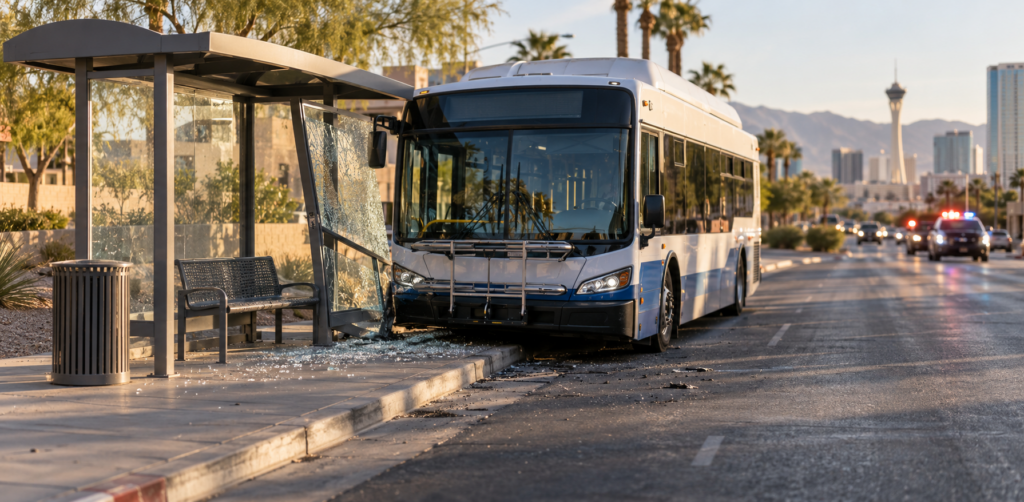
Liability means who can be held financially responsible when bus accident victims are hurt in bus crashes, incidents at bus stops or shelters, or while boarding and exiting. Accidents at bus stops can involve multiple potentially liable parties, depending on the cause, and Nevada law allows multiple parties to share liability in bus accidents.
The main categories of potentially liable parties include:
- The bus driver (RTC, school bus, shuttle, or charter)
- The bus company or employer
- RTC or another public transit agency
- The school district
- The city or county that designed or maintained the bus stop or shelter
- A negligent third-party driver who caused the bus crash
- A vehicle or equipment manufacturer
RTC and Public Transit Claims (Special Government Rules)
The Regional Transportation Commission of Southern Nevada plans and funds public transit across Clark County. RTC Transit operates dozens of bus routes and thousands of bus stops across the Las Vegas Valley. Private contractors often run the actual city bus fleet and employ the drivers, which can change who gets sued and whether a government cap applies.
RTC and similar transit authorities are treated as government entities under Nevada’s Tort Claims Act, which waives sovereign immunity but requires a written claim in tort filed with the governing body, imposes a damages cap per claimant, and bars punitive damages under NRS 41.035. Claims against RTC are subject to a $200,000 damages cap, and public entities in Nevada face that same cap on recoverable damages in bus accident cases.
Here is how an RTC bus accident claim typically progresses:
- Report the bus crash to RTC or the contractor and to the police
- Collect incident and crash report numbers, and note the bus number
- File a formal claim in tort with the governing body under NRS 41.036 — a separate task from filing suit
- If the claim does not resolve, file a civil lawsuit in the proper Nevada court
The RTC bus accident claim process is different from a normal auto claim. Identifying the correct governing body, the operating contractor, and the applicable cap takes time that an ordinary auto claim does not require, which is why early legal review matters even though the filing period is the same two years that applies under NRS 11.190(4)(e).
Shuttle, Charter, and Private Buses vs. Public Buses
Private carriers operate throughout Southern Nevada: hotel shuttles along the Las Vegas Strip, casino and airport shuttle buses serving Harry Reid International Airport, tour operators running sightseeing routes, and charter buses for corporate or church groups. These are not government entities, so government tort-claim rules do not apply.
Nevada law treats bus companies like these as common carriers with heightened responsibilities. A common carrier’s heightened duty of care means they must use the highest degree of care consistent with practical operation, not just ordinary care. This is to ensure passenger safety.
The contrast matters for your bus accident claim:
| Factor | Public (RTC) | Private Shuttle/Charter |
|---|---|---|
| Government claim in tort | Required (NRS 41.036) | Not required |
| Damage cap | Current statutory cap applies | No government cap |
| Punitive damages | Not available (NRS 41.035) | Available for reckless conduct |
| Insurance | Self-insured or pooled | Commercial policies, often high limits |
School Bus and Bus-Stop Laws in Nevada

Nevada law governs school buses and school bus stops under negligence rules and specific traffic laws designed to protect children. The most important is NRS 484B.353, which addresses passing a stopped school bus with a flashing stop-arm.
Under NRS 484B.353, drivers must stop when a school bus in front of them displays flashing red lights or extends the stop-arm. On two-way, undivided roads, traffic in both directions must stop and stay at least 25 feet away. Drivers may proceed only when the lights stop flashing, the stop-arm retracts, or a police officer directs them to move. Vehicles on the opposite side of a divided highway separated by a physical barrier are usually exempt.
When a driver commits a failure-to-stop-for-school-bus Las Vegas-style violation and injures a child or parent at a bus stop, that violation can support a civil negligence per se claim in addition to traffic citations. Liability in school bus and bus-stop crashes may rest with the school bus driver or school district for unsafe driving or careless loading and unloading, a private contractor operating school buses under contract with the Clark County School District, or a negligent third-party driver who runs the stop-arm or rear-ends the bus. The first two are typically government-tort-claim defendants subject to the damage cap; the third is treated like any other motorist with no cap.
Illegally passing a school bus can result in fines, demerit points on a driver’s license, and possible driver’s license suspension. While those are traffic matters, they create important evidence—including traffic citations—for later personal injury claims and injury victims seeking financial compensation.
Accidents at the Bus Stop or Shelter Itself
Bus stop accidents can happen without contact with a bus. A vehicle may leave the road and strike people near the curb. A damaged bench, loose panel, missing physical barrier, unstable shelter, or dangerous walking surface may also cause injury. “Nevada bus shelter accident law” is usually a mix of negligence, property control, and government-liability rules, not one shelter statute.
Control of the site must be verified. NRS 277A.330 directs the regional commission in a county of at least 700,000 people to provide for transit benches, shelters, and stops. It allows work through an exclusive franchise and requires agreements with the government entity controlling a public right-of-way.
Therefore, responsibility may rest with the RTC, a city or county, a contractor, or another property controller. Photograph the condition and posted stop identifier before repairs change the scene.
What Compensation Can You Recover
Compensation depends on the injury, proof of causation, available coverage, and each party’s fault. Economic damages may include ambulance and hospital charges, later medical expenses, rehabilitation, future care, lost wages, and reduced earning ability. Non-economic damages may address pain, emotional harm, disability, and lost activities. Keep medical bills, pay records, and written work restrictions to document losses.
How much compensation is available also depends on the defendant. The $200,000 limit in NRS 41.035 can restrict a covered claim against a government entity, and that government tort award bars punitive damages. A private bus company or negligent third-party driver may face different limits and insurance coverage.
How Long Do You Have to File in Nevada?
Most Nevada lawsuits seeking damages for personal injury or wrongful death must be filed within two years under NRS 11.190(4)(e). For a tort claim against a political subdivision, NRS 41.036 separately requires filing the claim with the governing body within two years after accrual. Those periods currently match in the statutes, but they are not the same task. Different facts can affect when a claim accrues, which defendant receives notice, and whether an exception applies. Do not use the general deadline to postpone an RTC filing or legal review.
Frequently Asked Questions
Who is liable in a Nevada bus accident?
Liability depends on who was careless and which bus was involved: RTC or another public transit agency and its driver for negligent operation of a city bus, a private shuttle or charter bus company for unsafe driving or poor maintenance, the Clark County School District or a contractor in school bus crashes, a negligent third-party driver who rear-ended the bus or hit people at the stop, or a city or county for dangerous bus stop design. Multiple parties may share fault, and Nevada’s comparative negligence law allows recovery as long as the injured person’s share is 50% or less.
How do I file a claim against the RTC in Southern Nevada?
Get immediate medical attention and report the crash to police. Request the RTC incident or claim number and identify the actual operating contractor if possible. Consult an experienced attorney who can prepare and submit a written claim in tort that complies with NRS 41.036. If the claim does not resolve, file a lawsuit within the two-year statute of limitations under NRS 11.190. The government claim is a separate step from filing a lawsuit, and identifying the right recipient takes time.
How long do I have to sue after a bus accident in Nevada?
In most Nevada bus accident cases, the deadline is two years from the date of the accident under the Nevada bus accident statute, NRS 11.190(4)(e). When a government entity like RTC or a school district is involved, a separate claim must also be filed with the governing body under NRS 41.036, which currently runs on the same two-year period. Accrual rules and exceptions can change the analysis, so don’t wait even a few months to get legal advice.
What are Nevada’s school-bus stop laws for drivers?
Under NRS 484B.353, drivers must stop for a stopped school bus displaying flashing red lights or an extended stop-arm on most roads, including throughout Las Vegas. Remain stopped until the signals stop and the arm retracts, unless a police officer directs otherwise. Vehicles on the opposite side of a divided highway with a physical barrier do not always have to stop. Drivers who illegally pass a stopped school bus face fines, demerit points, and civil liability if they injure anyone at the bus stop.
Do I need a lawyer if I was a bus passenger and not at fault?
Injured passengers are rarely at fault in bus accidents or sudden-stop incidents, but these claims can involve multiple parties—the bus company, RTC, a negligent third-party driver, maintenance contractors, and possibly a city or county—with overlapping insurance policies. A personal injury attorney can identify every liable party, send preservation letters to preserve bus video and data, gather medical records and employment proof, and ensure you meet government claim and statute deadlines while you focus on healing. Do not speak with insurance companies before consulting a bus accident lawyer.
Hurt in a Las Vegas Bus Accident? Talk to Temple Injury Law
If you or a family member were hurt in an RTC bus crash, shuttle bus accident, charter bus collision, or school bus stop incident anywhere in Southern Nevada, we are here to help. Temple Injury Law represents accident victims across Clark County—residents and visitors alike.
We offer a free consultation with no upfront fees. Contact us today so we can explain Nevada bus stop accident laws and help you understand your options for seeking fair compensation.

Jeff Temple focuses his practice in the area of personal injury. As a skilled personal injury attorney, he handles a broad range of cases including motor vehicle accidents, premises liability, and wrongful death. He is a graduate of the Radford University, he later attended the University of Miami School of Law and studied abroad at University College London. Upon graduating, Jeff relocated to Las Vegas and founded Temple Injury Law in 2022.

