
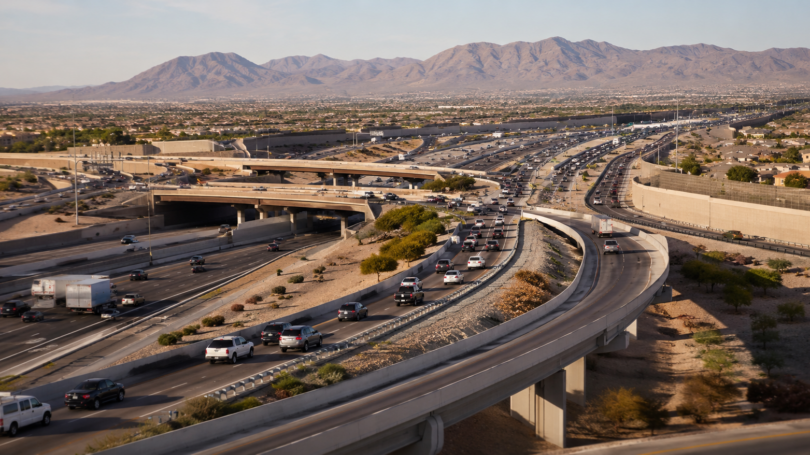
The Blue Diamond Road and I-215 interchange is a major regional traffic hotspot — and one of Southwest Las Vegas’s most dangerous areas for drivers. Where SR-160 feeds into I-15 and the I-215 Southern Beltway, a mix of roads, ramps, and high-speed merging areas creates conditions that lead to serious crashes year after year.
If you drive through Enterprise, Mountain’s Edge, or anywhere in the southwest valley, you already know this interchange demands your full attention. And if you’ve been hurt here, you need to understand why these crashes happen, who may be liable, and what to do next.
Injured in a crash on Blue Diamond or the 215? Call Temple Injury Law for a free consultation.
Why the Blue Diamond / I-215 Interchange Is So Dangerous
The risk of a Blue Diamond road accident grows when drivers must read signs, choose a ramp, and adjust speed at nearly the same time. Blue Diamond Road is also State Route 160, the route that connects Pahrump to the Las Vegas Valley. As SR-160 Las Vegas traffic reaches the urban area, it meets Clark County’s CC-215 Southern Beltway and I-15 near Las Vegas Boulevard.
The road design adds another layer. A collector-distributor (CD) road runs beside I-15 and separates entering and exiting vehicles from through traffic. NDOT closure notices show how the Blue Diamond flyover, the I-215 ramps, the I-15 mainline, and the CD road work as connected parts. This design manages traffic flow, but it also asks drivers to identify the correct lane early. A late change can put one vehicle beside another at highway speed.
Growth in Enterprise, Mountain’s Edge, and the rest of Southwest Las Vegas adds local trips to regional travel. During a traffic surge, a free-flowing ramp may quickly lead to reduced speeds ahead. That speed difference can leave little room for error.
Common Crashes in the Corridor
The broader Blue Diamond corridor has experienced recurring severe-collision issues. Common contributing factors to collisions include failing to yield and speeding, but the interchange layout itself shapes the types of crashes that happen most often.
- Rear-end collisions from sudden backups. During rush hour, traffic on the collector-distributor road and ramp queues can slow abruptly while trailing vehicles are still approaching at freeway speed. Limited sight lines near sound walls and ramp curves reduce reaction time.
- Merge and sideswipe crashes. Drivers merging from SR-160 onto I-15, or weaving between I-215 and I-15, face short lane-change distances. Vehicles must accelerate, change lanes, cross multiple lanes, and match mainline speed, all within a compressed zone. These conditions produce sideswipe collisions regularly.
- High-speed crashes. Speed differentials between vehicles entering from ramps and those on the mainline can lead to loss-of-control scenarios. A vehicle decelerating on an exit ramp while adjacent traffic flows at 65 mph is a collision waiting to happen. Reckless driving also contributes to crashes at this interchange.
- Impaired driving incidents. The corridor has seen DUI-related crashes on the collector-distributor road between Blue Diamond and the beltway. These crashes tend to happen at night and often involve catastrophic injuries or fatalities.
- Motorcycle crashes. The area is known for motorcycle crashes. Merge zones with inconsistent sight lines and sudden lane splits make motorcyclists particularly vulnerable — drivers may not see a rider until it’s too late, especially in low light.
Recent Crashes Show the Risk
The interchange has frequent multi-vehicle collisions, and recent years have made the pattern unmistakable. In July 2026, an eight-vehicle injury crash involving a semi-tractor-trailer shut down multiple lanes of I-15 south near I-215, with two people transported to the hospital. That kind of chain-reaction pileup is exactly what short merge zones and heavy truck traffic produce.
In October 2025, Nevada State Police investigated a fatal multi-vehicle crash on a connector linking I-15, I-215, and Blue Diamond Road — a reminder that danger zones extend beyond the mainline onto ramps and CD roads. Separately, KTNV reported a fatal crash on the northbound I-15 collector-distributor road between Blue Diamond Road and the 215 beltway, where the driver was arrested for suspected DUI.
Together, these crashes point to a recurring safety problem across the I-15/I-215/Blue Diamond interchange, consistent with broader Las Vegas crash data on high-volume corridors. Heavy traffic, heavy truck traffic, short merge zones, and difficult lane changes increase the risk of multi-vehicle collisions. Future improvements should prioritize crash reduction alongside traffic flow and capacity.
Who Is Liable in a Blue Diamond Interchange Crash

Liability usually rests with the person or business whose negligence caused the collision. The police report, vehicle damage, video, witness accounts, phone records, and event data may tell different parts of the story. Potentially responsible parties include:
- A careless driver who followed too closely, made an unsafe lane change, sped, or drove while impaired.
- More than one driver when separate actions combined to cause a multi-vehicle crash.
- An employer or commercial carrier may be liable when a worker caused the collision while acting within the scope of employment, subject to the facts and Nevada law.
- A vehicle owner or maintenance provider may be liable when negligent entrustment or a proven mechanical failure contributed to the impact.
- A public entity may be liable in the uncommon case where evidence supports a claim involving dangerous design, maintenance, or warnings. Nevada government claims are subject to special rules and immunities under NRS 41.031 through 41.036, so early attorney review matters.
Nevada also applies modified comparative negligence. Under NRS 41.141, a claimant’s award can be reduced by that person’s percentage of fault. A claimant who is 51% or more responsible generally cannot recover from less-responsible defendants.
What to Do If You’re in a Crash on Blue Diamond or the 215
- Move out of active traffic if you can do so safely. Turn on your hazard lights. Ask for medical help, and accept an evaluation if you have pain, dizziness, confusion, or other symptoms.
- Call 911. Nevada State Police Highway Patrol (often called NHP) may handle a freeway or state-route scene, while the Las Vegas Metropolitan Police Department may respond on nearby local roads. Dispatch will send the proper agency based on the exact location.
- Document what you can without entering a live lane. Photograph vehicle positions, damage, debris, signs, lane markings, the ramp or exit, weather, and visible injuries. Get witness names and contact information.
- Be careful with insurance questions. Provide truthful, basic information and notify your insurer as required by your policy. Do not guess, minimize an injury, or give a recorded statement to another driver’s insurer before getting legal advice. If your carrier requests a statement, ask counsel how to meet your policy duties without harming your claim.
- Request a legal review promptly. Camera footage, vehicle data, and physical road evidence can be lost or overwritten long before the filing deadline.
Our Blue Diamond Office Serves This Corridor
Temple Injury Law’s Southwest office is at 8085 Blue Diamond Road, Unit 103, Las Vegas, NV 89178. It is located to help people in Enterprise, Mountain’s Edge, and nearby Southwest Las Vegas communities following a crash in the corridor. Our team can review the route you traveled, identify which agency handled the scene, gather available evidence, and communicate with insurers.
If you need local help, learn more about our Blue Diamond office and the communities it serves.
How Long Do You Have to File in Nevada?
Under NRS 11.190, you generally have two years from the date of injury to file a personal injury claim in Nevada. That deadline applies whether your crash happened on Blue Diamond Road, I-215, or any other road in Clark County.
Some situations can change that window. Claims involving government entities follow a separate process with their own filing requirements and limits on recovery, and individual agencies maintain their own claim forms and procedures. Tolling may apply if the injured person is a minor or is incapacitated. Acting quickly matters: skid marks fade, road conditions change during construction, surveillance footage gets overwritten, and insurance deadlines begin running immediately.
Frequently Asked Questions
Is Blue Diamond Road dangerous compared to other Las Vegas corridors?
The Blue Diamond Road and I-215 interchange combines conditions that raise crash risk: collector-distributor lanes, high-speed merges, heavy truck traffic, short lane-change distances, and rapid residential growth feeding local trips onto a regional route. Those features make the corridor demanding for drivers, and serious multi-vehicle crashes are reported there regularly.
Who’s liable when multiple cars are involved in an interchange crash?
Nevada’s comparative negligence system allows fault to be split among all responsible parties. In a chain-reaction crash, multiple drivers may share liability based on each one’s actions. An attorney can review police reports, traffic camera footage, and witness statements to determine each party’s share.
Can I sue for poor road design at the Blue Diamond interchange?
Potentially. If inadequate signage, short merge distances, or missing safety features contributed to your crash, a claim against a government entity like NDOT may be possible. These cases require expert engineering testimony and follow a separate claims process from claims against private parties, so legal counsel is essential.
How long do I have to file a claim after a crash in Nevada?
Most personal injury claims must be filed within 2 years of the date of injury under NRS 11.190. Claims against government agencies follow different procedural rules. Don’t wait — evidence preservation and early investigation are critical.
Hurt on Blue Diamond or the 215? Talk to Temple Injury Law
If your memory of the collision is only a Blue Diamond flyover sign, a sudden backup, and an ambulance ride, that is still a usable starting point. The interchange is complicated enough that reports may label the location as SR-160, the I-15 collector-distributor road, or a 215 ramp. Our office at Blue Diamond Road can help match those details to the correct scene and claim options. Schedule a free consultation to review your case.

Jeff Temple focuses his practice in the area of personal injury. As a skilled personal injury attorney, he handles a broad range of cases including motor vehicle accidents, premises liability, and wrongful death. He is a graduate of the Radford University, he later attended the University of Miami School of Law and studied abroad at University College London. Upon graduating, Jeff relocated to Las Vegas and founded Temple Injury Law in 2022.

